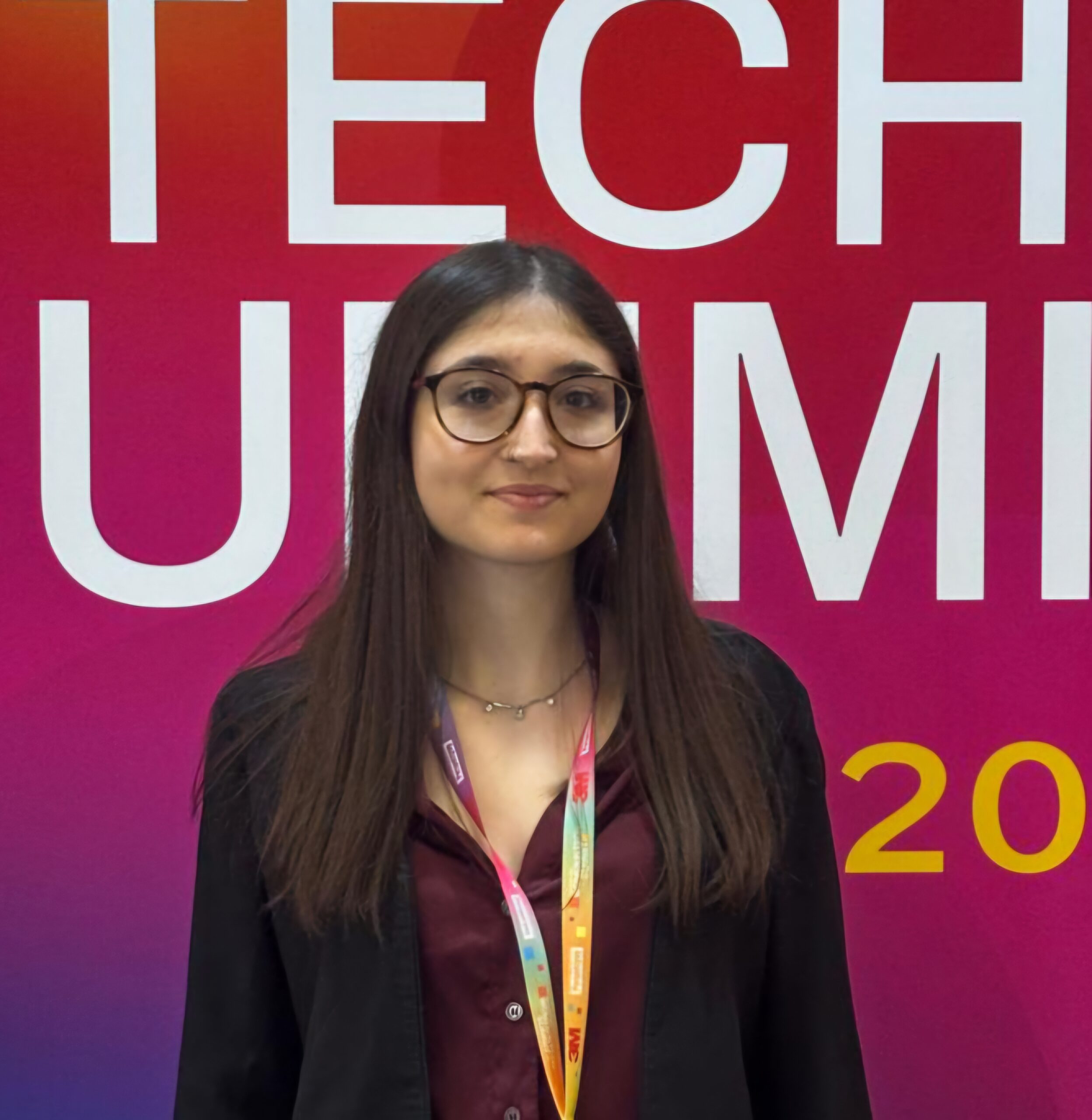
Alice Zurru has won second prize in the KHMW Young Talent Graduation Awards for Mathematics. Originally from Italy, she completed her bachelor’s degree in Mathematics for Engineering at the Politecnico di Torino before deciding to continue her studies in the Netherlands, at Delft University of Technology.
‘I wanted to gain international experience,’ she explains, ‘because I think it can enrich your life.’ What attracted her to the Netherlands was the fact that education here is more practically oriented than in Italy. ‘Both theoretical and applied approaches have their value. But I was more interested in the practical applications.’
She thoroughly enjoyed student life in Delft. ‘It’s a small city, and you meet students everywhere. It’s also a very international community, with lots of activities being organised. That makes it easy to make friends.’ The language is still something of a barrier, so she has had relatively little contact with Dutch people. But she has decided to work on her Dutch next year.
The Dutch education system has lived up to her expectations. As part of her master’s programme in Applied Mathematics, she completed two internships: first at Sioux Technologies in Eindhoven, and then at TNO in Amsterdam. At TNO, she worked on what would also become the subject of her master’s thesis: developing optimisation models for planning energy systems under uncertainty, using stochastic optimisation.
‘With renewable energy, there are all sorts of uncertainties,’ she explains. ‘We developed a stochastic programming model that allows us to consider different scenarios, for example involving demand and the availability of the sun or the wind. Considering a set of future scenarios provides a more solid basis for decision-making.’
She believes that mathematics can play an essential role in societal challenges such as the energy transition. ‘Mathematics can provide guidance when decisions involve uncertainty. Mathematical models help to reduce that uncertainty.’
Alice did encounter setbacks during her research. ‘I was told there were two approaches we could use and compare. After running a few simulations, I realised that the results weren’t what we expected. My supervisor helped me see that this wasn’t a disaster at all. After all, we do research to understand things better. So I started again from scratch, step by step. And eventually we figured out what was going on.’
This initial setback did not discourage her. ‘When I started my thesis, I wasn’t sure whether I wanted to pursue a career in academia or industry. Working on my thesis inspired me to continue my studies.’
Alice has recently started an accelerated PhD programme, lasting three years rather than four, because her doctoral research builds on the work she did for her master’s thesis. For her PhD, she will continue working on stochastic programming, focusing on scaling up the results to realistic energy systems.
‘It’s very important to me that my work challenges me mathematically, while at the same time allowing me to contribute to something bigger than myself.’
Alice is an ambassador for Women in Science, a collaboration between ten European universities that supports women in science, technology, engineering and mathematics. ‘It’s important to show that women can succeed in these fields. That for every Alan Turing, there’s also an Ada Lovelace.’
Alice herself experienced little opposition during her studies. And yet… ‘In my first year, 80 or 90 per cent of the students were male. When there are so few women, it’s difficult to make female friends.’
The atmosphere among the students also affected her confidence. ‘When I heard one of the boys saying that everything was really easy, I’d think: well, I don’t find it that easy. Boys are taught to be brave, while girls are taught to be very precise and perfectionistic. The way we’re brought up affects women’s self-confidence.’
As a Women in Science ambassador, Alice wants to show that you don’t have to be a genius to succeed in STEM subjects. She sees herself as a perfectly ordinary person. ‘I want women to think: if she can do it, so can I.’