
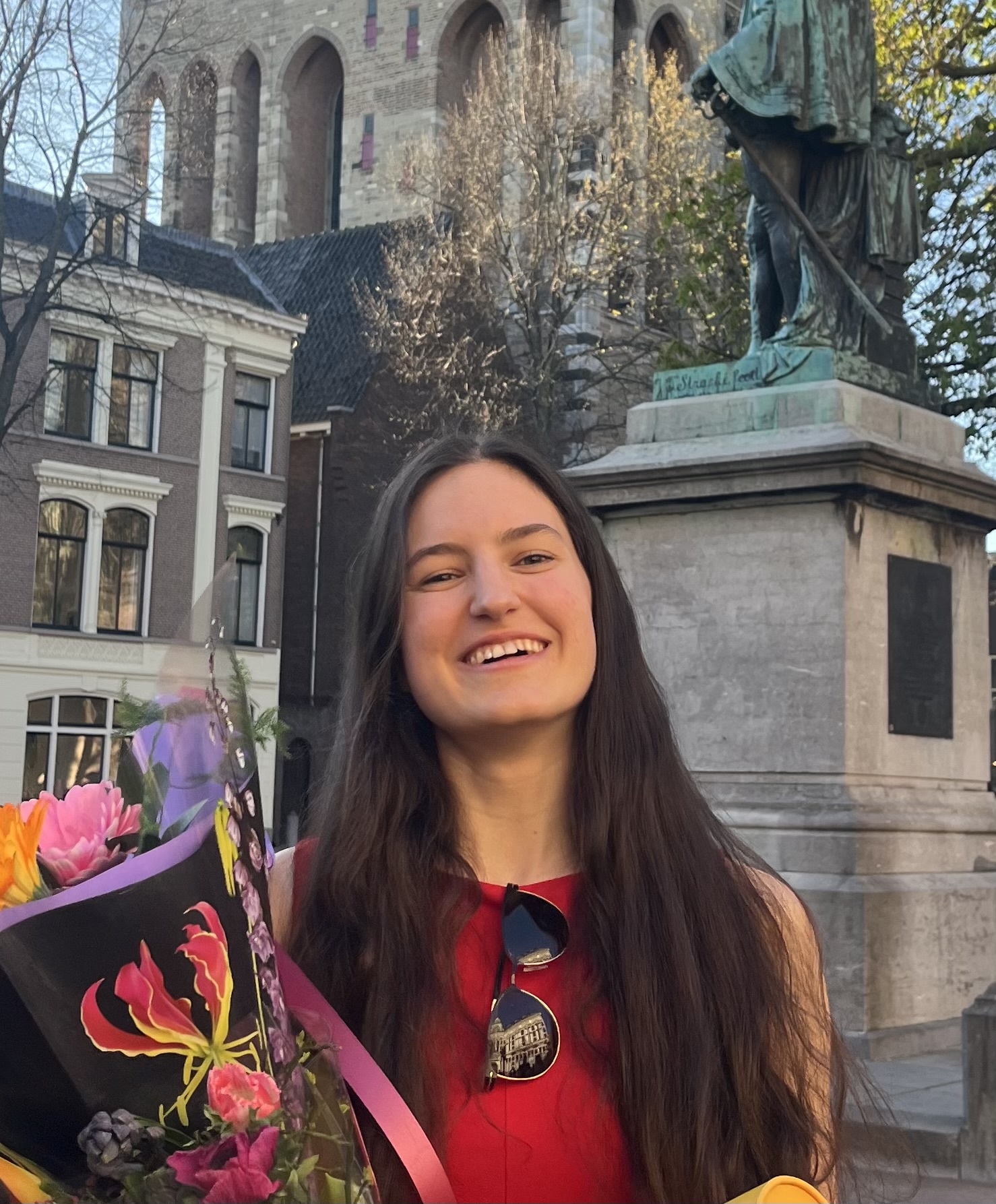
Antibodies are among the most powerful medicines available today. They can be designed to bind very precisely to specific targets, making them valuable in the treatment of diseases such as cancer and immune disorders. Yet they have one important limitation: they cannot enter cells on their own. Nataliia Voloshyna, winner of the first prize in the Dr Saal van Zwanenberg Research Awards, investigated how this obstacle might be overcome.
‘Antibodies are incredible therapeutics,’ she explains. ‘We can make them bind almost any target, with very high affinity, and we can produce them on a large scale. But many of the targets we want to reach are inside the cell, and antibodies cannot get there by themselves.’
For her master’s thesis, Nataliia explored different ways of transporting antibodies into cells. One approach involves attaching molecules called ligands to an antibody. These bind to receptors on the cell surface, allowing the antibody to be taken into the cell. Another method uses cell-penetrating peptides, small molecules that can enter cells themselves and carry the antibody along with them.
Both approaches had been studied before, but Nataliia noticed that researchers rarely compared them directly.
‘Different people were working on different methods, but nobody was really putting them together in one experiment to see which one worked better for which application. That makes it difficult to choose the best approach.’
She therefore set out to compare the methods systematically. How much of the antibody entered the cell? How quickly did it happen? And where did the antibody end up once it was inside?
The results challenged some existing assumptions. The ligands that Nataliia and her colleagues were working with turned out to be much less effective than they had expected.
‘We made them, tested them, and found that they weren’t performing nearly as well as we thought they would. These were the kinds of molecules people in the field were already using.’
Rather than being simply disappointing, this unexpected finding opened up a new line of research. If the ligands were less effective than assumed, perhaps they could be improved considerably.
‘We realised there was still a lot of room for optimisation. That led to another project, which is still ongoing.’
The comparison also revealed an interesting difference in how the two delivery methods worked. When antibodies entered cells through receptors, the process started slowly, with increasing amounts being taken up over time. With cell-penetrating peptides, the opposite happened: uptake was initially high but gradually declined.
‘That could be useful for different applications,’ Nataliia explains. ‘With receptor-mediated delivery, you get more and more antibody inside the cell over time. With peptides, you get a lot at the beginning.’
Neither method is necessarily better in every situation. Their different characteristics may make them suitable for different purposes.
Although Nataliia’s research was conducted in the laboratory rather than in a hospital, its ultimate relevance lies in improving treatments for patients. Her project was not focused on one particular disease, but on a problem that affects the development of many antibody-based medicines.
‘We focus on patients and on improving drugs for them. If a drug isn’t optimal, we try to make it better – for example, by reducing side effects or improving how strongly it binds to its target. That might mean patients need a lower dose or less frequent treatment.’
At the same time, she is careful not to promise immediate medical applications. Developing a successful treatment requires much more than demonstrating that a method works in the laboratory.
‘The molecules we’re working on are intended for clinical applications. But whether they will actually get there, we don’t know.’
What particularly appeals to Nataliia is the interplay between practical medical problems and fundamental scientific questions. Researchers may begin with a clear goal, but their experiments often lead them somewhere unexpected.
‘A lot of the time, we get results that we don’t fully understand. That sparks new fundamental questions, and then we start exploring those as well.’
Her own master’s research is a good example. An attempt to compare existing delivery methods revealed weaknesses in molecules that were already widely used, creating opportunities for further research.
Originally from Ukraine, Nataliia moved to Poland at the age of eleven and came to the Netherlands when she was eighteen. She completed both her bachelor’s and master’s studies in Utrecht and has now started a PhD.
Her enthusiasm for scientific research has only grown. ‘At the moment, I can’t see myself doing anything else. I think this is really my sweet spot.’
For now, Nataliia sees her future in science. Outside the laboratory, however, there is plenty more in her life. She enjoys exercising, cooking and playing the violin in a student orchestra. But above all she likes spending time with friends. ‘I get a lot of my energy from people. My friends is very important to me.’