
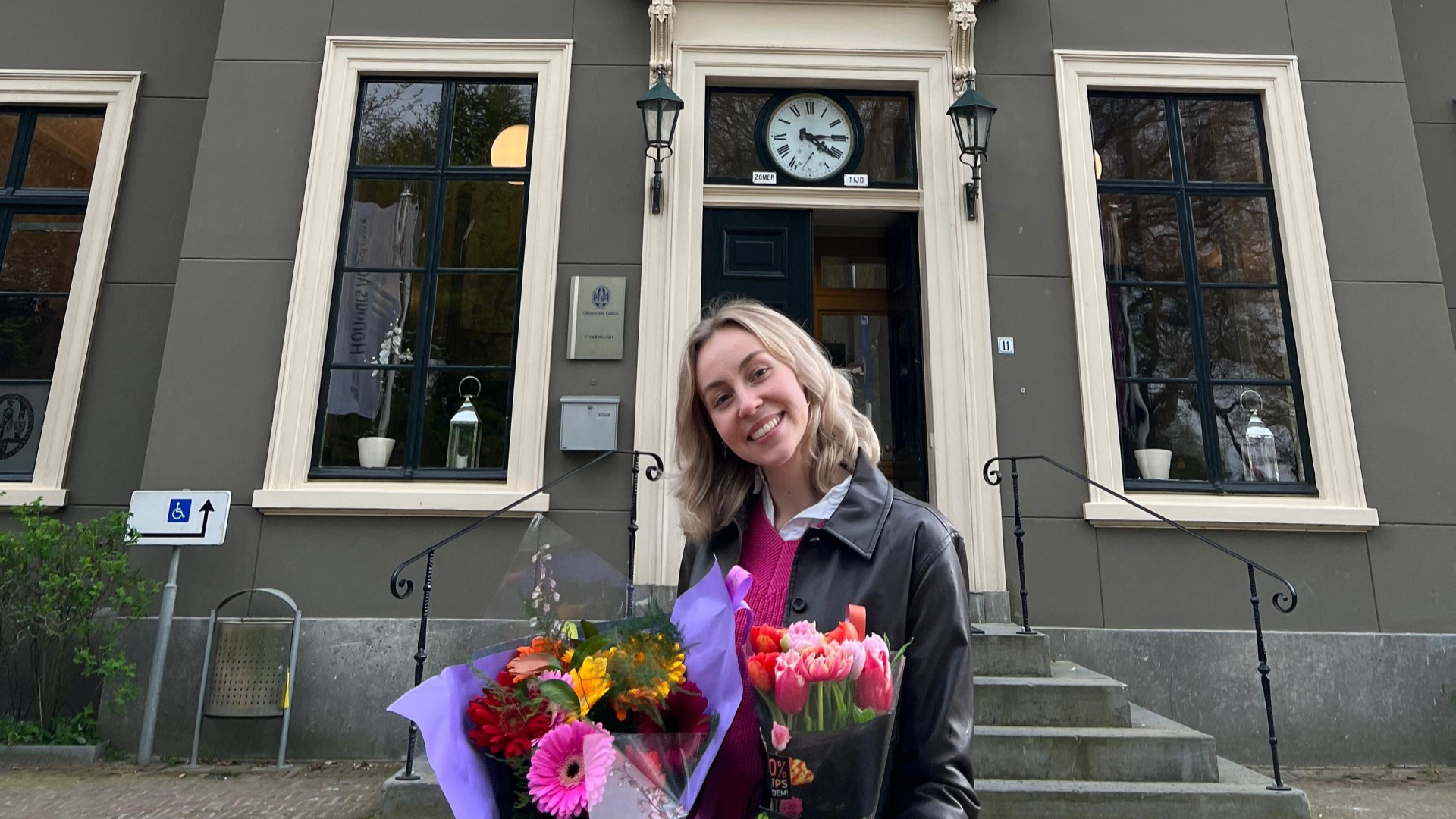
Saphira Brandenberger is fascinated by exoplanets: planets beyond our own solar system. Could any of them support some form of life? For her master’s thesis, she developed a method for selecting promising candidates for further study. Her work has earned her one of the two KHMW Young Talent Graduation Awards for Astronomy.
Until she was fourteen, Saphira wanted to become a vet. “I still absolutely love animals. Whenever I see an animal, I try to make friends with it.” Looking back, she sees a connection with her current work: what fascinates her is life itself. Could it also exist beyond Earth?
She discovered astronomy while working on a research project at secondary school in Austria. “I got goosebumps as I learned more about it. This is it, I thought. I went to my mother and said: I want to study astronomy.”
After her bachelor’s degree in Vienna, she wanted to continue her studies abroad. By then, she knew she wanted to focus on exoplanets and chose the master’s programme in Astronomy at Leiden because of its expertise in the field. Having completed her master’s in Leiden, she has now started a PhD at the University of Groningen. She enjoys life in the Netherlands. “Everywhere I go, I meet people who want to help me and think things through with me. And I’ve made some good friends here.”
For her thesis, Saphira focused on cold sub-Neptunes, exoplanets between Earth and Neptune in size. Since we cannot visit them, researchers have to base their knowledge on information that reaches us through light. This allows them to infer, among other things, a planet’s size and mass. Sometimes they can also measure the spectrum of its atmosphere: a kind of fingerprint in the light that offers clues to the substances present.
But this does not yet tell us what such a planet is like inside. Is it mostly rock, or does it have a thick layer of gas? Different compositions can be consistent with the same observations.
Finding out more requires further observations. These, however, take up a great deal of telescope time. “We can’t study every planet.” Saphira’s method is intended to help researchers choose. For each planet, Saphira’s model explores a range of possible interiors that fit its measured size and mass. It then asks how often conditions just beneath the atmosphere would allow water to remain liquid. The model additionally estimates how easily astronomers could study the planet further.
Together, these assessments produce a ranking. A planet may look promising, but be so difficult to observe that another candidate is better suited to further study. The method does not establish whether a planet is habitable. “We look at liquid water because it is considered a prerequisite for life as we know it. But life needs much more than that, of course.”
Saphira Brandenberger in front of the Old Observatory, Leiden
Why put so much effort into studying planets we cannot travel to with our current technology? Saphira is often asked this by friends outside astronomy. She has asked herself the same question. For her, the answer lies in the value of knowledge, even when it has no immediate application. “The pursuit of knowledge has always driven humanity forward. It is part of who we are and what we have been doing for as long as we have been on this planet.”
She compares science with art, whose value cannot be measured solely by its practical uses either. Art can bring people together and help them step outside their own world. In her view, the search for knowledge does something similar. “We talk to each other, form groups and try to understand things together that we sometimes can’t even touch.”
For some people, the vastness of the universe feels frightening; it is too big to comprehend. Saphira wants to learn more about it. “Astronomy is so far removed from anything we experience on Earth. That’s precisely why I find it so interesting. By learning more about it, we also try to understand ourselves better as human beings.”
She enjoys sharing that enthusiasm. During her master’s, she took a course in science communication, where they discussed how carefully researchers need to word their findings. “As astronomers, we find exciting things almost every day. Sometimes someone is so enthusiastic about a discovery that they overstate it a little. People outside our field then think: we’ve found life on another planet! In reality, we’ve only reached the stage where we think there might be liquid water on some planets.”
Young people tell her about the stories circulating on TikTok: that the Earth is flat, or that nothing exists beyond our solar system. She therefore feels it is important for people to understand how scientific knowledge is scrutinised. An academic publication is the result of a lengthy process: researchers build on existing knowledge and have their work reviewed by their peers. “There can always be mistakes.” But she believes this scrutiny gives us more reason to trust a scientific source than an isolated claim someone posts online without any checks. “If you read something you find really remarkable or interesting, try to find a better source than just that social media post.”
Saphira has now begun her PhD in Groningen, on a topic that fits closely with the research she did for her master’s thesis. When she started her thesis in Leiden, she was not yet familiar with the Groningen research group. During her interview, it became clear how much their ideas had in common. “I can now apply everything I learned during my master’s.”