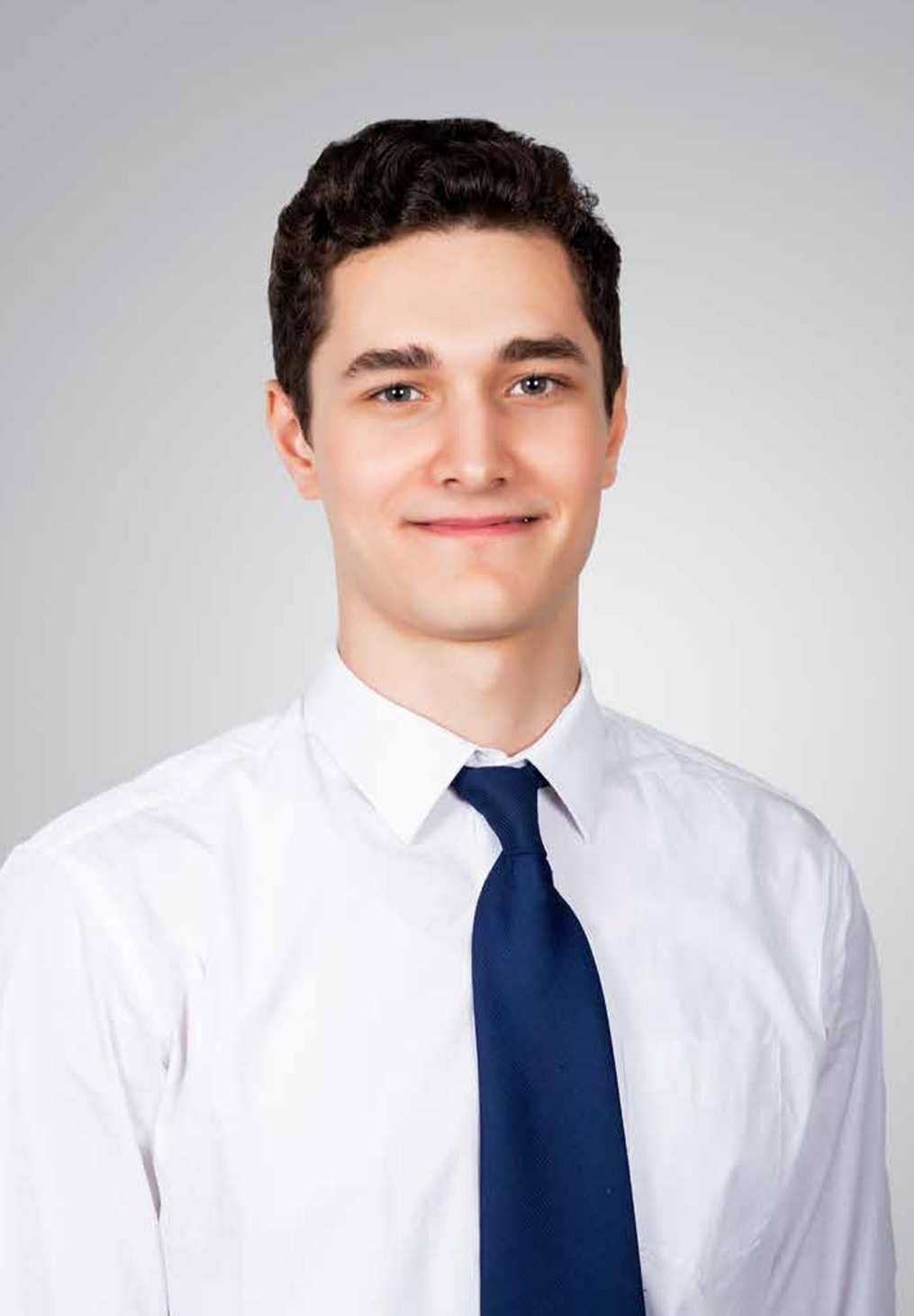
 Leo Sprincean keeps a small reminder of home in his student room in Groningen: a Moldovan flag hanging just behind him. Born and raised in Moldova, he moved to the Netherlands partly because his older brother was already studying in Groningen. “It made things easier for my parents, and for us as a family,” he explains. The choice for the University of Groningen aligned perfectly with his academic interests. Many English-taught chemistry programmes elsewhere focus heavily on specialised subfields, but Groningen allowed him to begin with a broader, more fundamental chemistry curriculum. “I wanted to start with something general and build from there.”
Before coming to the Netherlands, Sprincean had already distinguished himself internationally as an Olympiad competitor. He represented Moldova at three global science Olympiads: the International Junior Science Olympiad, where he earned a bronze medal, and the International Chemistry Olympiad twice, bringing home another bronze and an honourable mention. His achievements even earned him formal recognition from the Moldovan president—twice. “In Eastern Europe, Olympiads are seen as a major achievement,” he notes. “Schools actively prepare students for them. It’s more theory-focused, whereas in the Netherlands there is much more emphasis on practical skills. Both approaches have their strengths.”
Another formative experience was the Yale Young Global Scholars programme, where he joined a track dedicated to addressing global challenges. Working with students from all over the world broadened his understanding of scientific and social issues beyond his own environment. His group project explored the difficulties faced by albino children in Tanzania, particularly those related to genetic conditions and discrimination. “It really taught me how to approach problems outside my own community and to brainstorm with people from very different backgrounds.”
In the Netherlands, Sprincean is active on the board of Jong KNCV, the youth division of the Royal Dutch Chemical Society. He sees professional engagement as a crucial source of connection and support. “It helps you discover opportunities, collaborate, and meet people who share your passion. Academic life can be challenging. Talking to people who’ve been through similar experiences makes a big difference.”
Looking ahead, he remains open-minded about his future field within chemistry. A recent summer research project in spectroscopy sparked his interest, but he intends to explore multiple areas before choosing a direction. What motivates him most is the support of his family and the opportunities he has been given. “My parents didn’t have the same freedom to pursue their passions. I feel grateful, and I want to make the most of the opportunities I have.”