
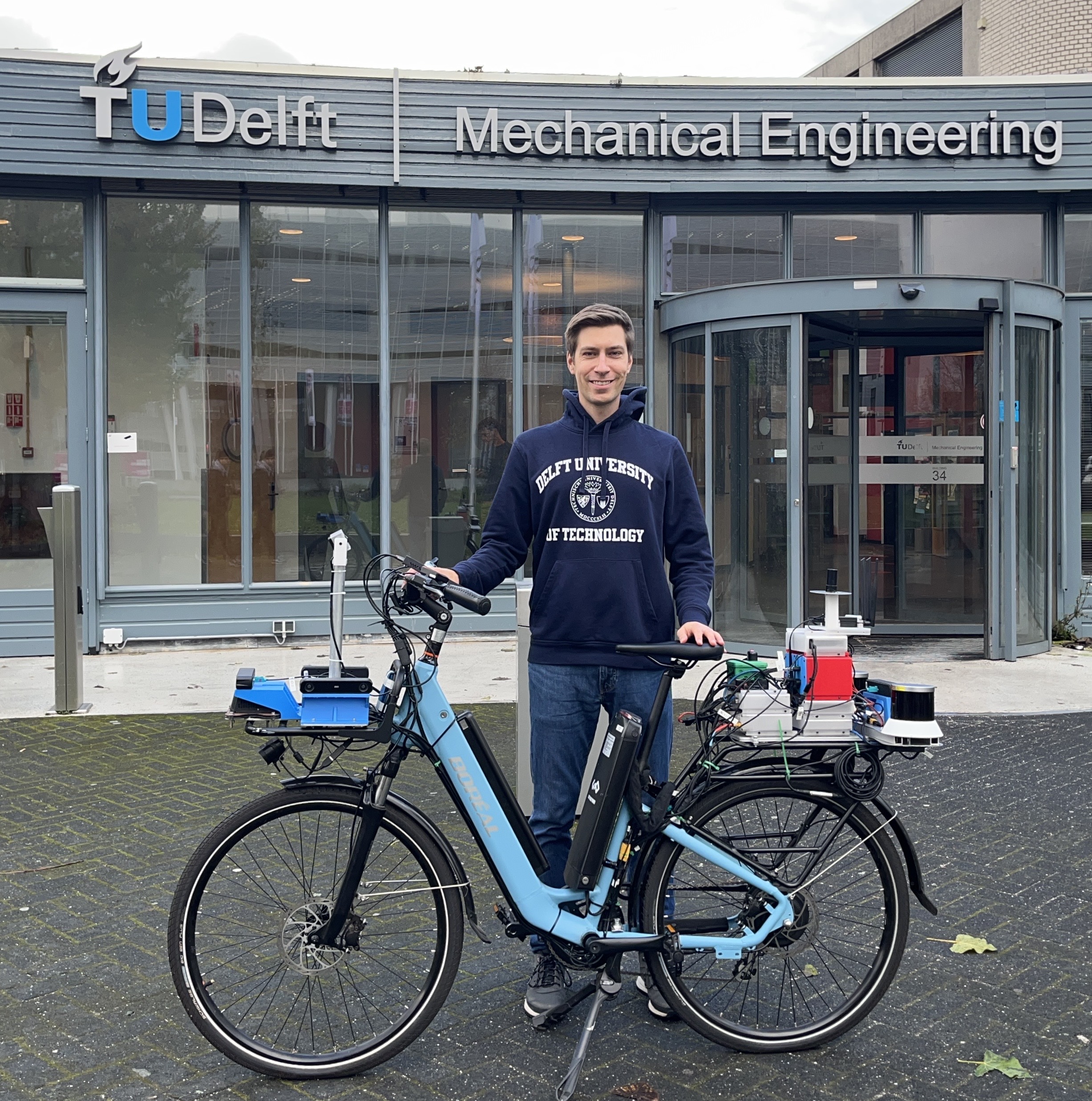
Most Dutch children learn to ride a bicycle at an early age. Once they have mastered it, they hardly ever think about how they manage to stay upright, turn corners or avoid obstacles. But teaching a machine to do the same is surprisingly complicated. Aleksander Seremak, winner of the first prize in the KHMW Young Talent Graduation Awards for Computer Science and Information Science, explored how artificial intelligence could learn these skills.
‘Riding a bicycle seems easy to us, but there’s a lot of complicated physics involved,’ explains Aleksander, who completed his master’s degree in Robotics at TU Delft. ‘To make a turn, you need to coordinate your speed, steering and the way you lean into the corner. We weren’t sure whether a neural network could learn all that. But it turned out it could.’
Rather than programming a machine with detailed instructions for every possible situation, Aleksander used a form of artificial intelligence training that learns from examples – imitation learning. His aim was to develop a system that could predict not only where a bicycle should go, but also how much it should lean while turning.
For his research, he used a TU Delft sensor bicycle, which he equipped with additional camera sensors. He then cycled approximately 180 kilometres through Delft, collecting around twenty hours of data. From these recordings, he selected five hours to train his AI model.
‘The cameras and sensors recorded everything happening around the bicycle. We measured its position very precisely, as well as its speed, steering and how much it leaned. That gave us a dataset unlike anything that had been available before.’
Using this information, he trained a neural network to predict the bicycle’s trajectory. The results were encouraging: the system learned to predict turns and the corresponding leaning movements.
But why teach a bicycle to ride itself? Aleksander sees several possible applications, from autonomous delivery bicycles to systems that help cyclists maintain their balance. More importantly, his research could contribute to making self-driving cars safer.
‘Most autonomous driving systems have been developed using data from places where there aren’t nearly as many cyclists as in the Netherlands. We don’t really know how these cars will behave around cyclists, particularly in busy European cities.’
His AI model could help address that problem by creating realistic virtual cyclists in computer simulations. These cyclists would be able to accelerate, slow down, and lean into corners just as humans do, allowing researchers to test how self-driving cars respond.
‘We can put these virtual cyclists into a simulated city and see whether autonomous cars behave safely around them. That’s where I think the research could make a real difference.’
Aleksander knows from experience how unpredictable cyclists can be. Having previously studied in Poland, he had to adjust to Dutch cycling habits.
‘Dutch cyclists are very chaotic!’ he laughs. ‘When I first arrived, I was cycling with a Dutch friend. We approached an intersection, and I looked towards an approaching car. My friend shouted, “Why are you looking at the car?” I said, “Because it’s coming!” He told me that if drivers realise you’ve seen them, they might not stop. I couldn’t believe it.’
He still considers himself a cautious cyclist. Outside the Netherlands, however, his favourite form of cycling is rather more adventurous. ‘My heart belongs to the mountains. I love mountain biking, riding up trails through forests and then going all the way down.’
Aleksander studied computer science in Kraków before coming to Delft. His interest in autonomous vehicles had already developed in Poland, where he worked on a student project involving a self-driving racing car. But he wanted to move beyond conventional industrial robotics.
‘I’ve always loved programming, but I also wanted to build something tangible. With software, you often can’t physically touch what you’ve created. Robotics brings those two interests together.’
He chose TU Delft because its Robotics programme allowed him to specialise in intelligent machines. The experience exceeded his expectations.
‘The knowledge I gained was incredibly valuable, but so were the people I met. I’m still working with several of them on new projects.’
One of those projects involves developing a robot to clean solar panels autonomously, particularly in Southern Europe, where dirt can significantly reduce their energy production. Another focuses on using four-legged robots, resembling robotic dogs, to inspect construction sites.
These projects reflect his broader ambition: to bring intelligent robots out of research laboratories and into the real world.
‘Robots could perform tasks that are dangerous or difficult for humans, such as inspecting hazardous industrial sites or assisting with search and rescue operations. That’s what really motivates me.’
Having graduated this summer, Aleksander is exploring his options, including doctoral research and positions in industry. Whether his future lies in the Netherlands, Poland, Switzerland or elsewhere matters less to him than the opportunity to work on intelligent robotics.
Yet he is far from uncritical about artificial intelligence.
‘Changes on this scale can’t have only positive consequences. There are risks, including the impact on employment. And with robotics, safety is absolutely crucial.’
Unlike AI systems that operate entirely on computers, physical robots interact directly with their surroundings. Mistakes can therefore have serious consequences.
‘A self-driving car can actually hurt someone if something goes wrong. So how do we measure and guarantee the safety of these systems? I think that’s one of the most important questions we need to answer.’
For Aleksander, making robots more intelligent and making them safer are inseparable challenges. His bicycle research brings those ambitions together: teaching machines a skill that humans take for granted, while helping them navigate a world full of unpredictable human behaviour.